
The Wrong Way Contrail
breaking out of the wrong theory...

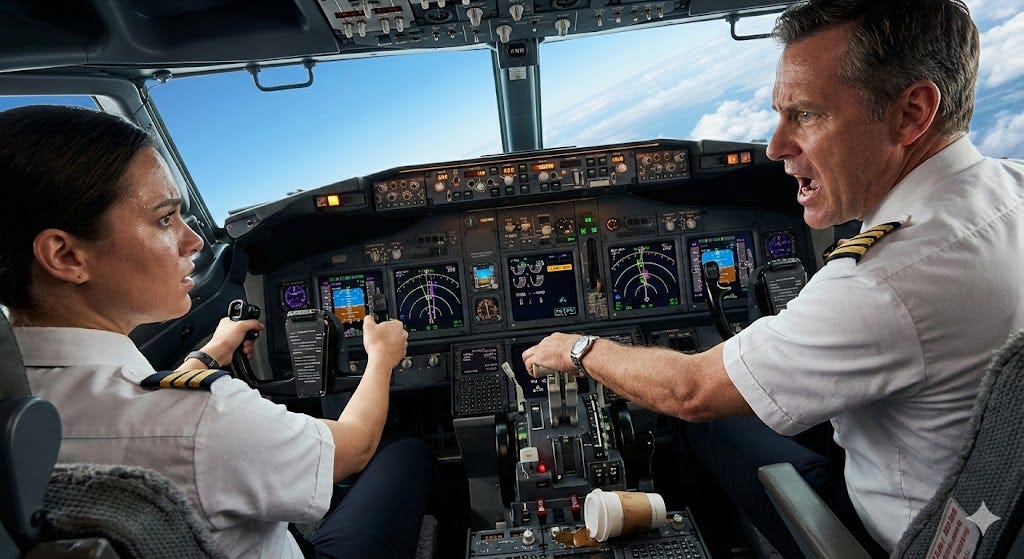
The cockpit of the 737 was an aerial sanctuary for Jamie and Reynolds. At 15,000 feet, the world outside was blue, the hours passing with ease as auto-pilot was engaged. In the left seat, Captain Reynolds was nursing a lukewarm coffee, his posture relaxed, a clipboard resting idly on his knee. Beside him, First Officer Jamie settled deeper into the sheepskin seat, eyes sweeping the panel with a rhythm that had become muscle memory.
“Altitude capture at one-five thousand,” Jamie said.
“Checked,” Reynolds replied, his voice practically horizontal with calm. “Speed stable.”
It was the lull of routine. The automation had handled the departure with such benign precision that the vigilance of the crew—usually a redundant safety net—had begun to slacken. It was a shared complacency between the first officer, the captain, and a corporation, which had a great safety record; it’s a silent agreement between Boeing’s designers and engineers with airline crews that the machine knew the way. Trust settled in the cockpit like a comfortable weight. Jamie’s scan slowed. Reynolds turned his eyes to the side window, watching a distant contrail form. Their shared experiences and trainings were perfectly consistent with the external world; there were no surprises here, only the comforting boredom of safety.
Then, the betrayal happened in a single, violent snag in the yoke.
It jerked forward, knocking Jamie’s hand aside. The nose pitched down, transforming the horizon from a stable line into a rising wall of patchwork green. Gravity lifted from their stomachs as the vertical speed plummeted, the aircraft diving at fifteen hundred feet per minute. Reynolds’ coffee cup hit the pedestal with a wet thud.
“What the—!” Reynolds barked, grabbing the glare shield.
The Master Caution light flashed. Simultaneously, the mechanical voice of the Traffic Collision Avoidance System (TCAS) blared through the headset: “CLIMB NOW. CLIMB NOW.”
Jamie froze. The shock was a physical blow, bypassing rational thought and striking directly at the amygdala. In that instant of startle, Jamie’s world contracted. The peripheral vision darkened, the field of view shrinking until the only thing that existed was the Attitude Indicator showing the dive. The Captain was shouting something, but Jamie couldn’t process the words.
The TCAS system screamed “CLIMB,” but neither pilot responded to it. They both registered the sound, but the overwhelmed brains, besieged by the visual and physical violence of the dive, gated it out completely. Inattentional deafness had claimed the entire flight crew.
Desperate to resolve this shock, Jamie’s mind grasped for a theory from flight school that could explain the violence. It found the wrong one. The rushing noise of the dive sounded like speed.
“It’s an overspeed!” Jamie shouted, voice cracking. “We’re too fast!”
It wasn’t an overspeed. It was a sensor failure feeding bad logic to the stall protection system, but Jamie’s shout acted as a contagion. This was Social Assimilation; Jamie was forcing the contradictory reality to fit the wrong mental model, and momentarily dragging the Captain into that same false frame. Reynolds, disoriented by the g-forces and trusting his First Officer’s instinct, hesitated, his hand hovering over the speed brake lever—an action that, in the actual stall logic scenario, would have been disastrous.
The cockpit was screaming contradictions. Jamie hauled back on the yoke, muscles coiled tight, fighting the automation. The aircraft shuddered, caught between the pilots’ panic and the computer’s error.
“I can’t stop it!” Jamie yelled. “It’s fighting me!”
The desperation in Jamie’s voice cut through Reynolds’ own startle. The Captain looked at the airspeed indicator. It was steady. He looked at the vertical speed. Plummeting. He looked at the TCAS. Green.
The “Overspeed” frame shattered in Reynolds’ mind.
“No!” Reynolds shouted, slamming his hand over Jamie’s on the throttles. “Not speed! Look at your trim! Jamie, look at the trim!”
The external intervention broke Jamie’s tunnel vision.
Aviate. Breathe. Check.
Jamie forced a ragged breath, physically commanding the hands to loosen the death grip on the yoke for a fraction of a second. The visual field widened. Jamie saw what Reynolds saw: the trim wheel spinning erratically on its own.
“It’s the trim,” Jamie realized, the clarity rushing in like cold water. “The auto-trim is fighting us.”
“Cutout!” Reynolds commanded.
With deliberate, heavy movements, Jamie reached for the cutout switches on the center pedestal. Click, click.
The ghost in the machine died. The trim wheel stopped its manic spinning. The erratic pitching ceased.
“I have manual control,” Jamie said, voice shaking but distinct.
“You have control,” Reynolds confirmed, his hands hovering defensively over the yoke.
Jamie pulled back, this time smoothly, guiding the nose up to the horizon. The dive shallowed, then reversed. The g-forces returned, heavy and reassuring. The crisis had lasted only thirty seconds, but the silence that followed was heavy with the realization of how close the false hypothesis had taken them to the ground.